

Season-by-Season Lawn Maintenance Calendar

Season-by-Season Lawn Maintenance Calendar

Follow our season-by-season lawn maintenance calendar to get a barefoot-worthy lawn and ensure great curb appeal.

Early Spring

Like so many maintenance jobs, everything goes smoother — and you’ll get better results — with proper preparation. Early spring is the time to get ready for lawn-growing and mowing season.

Related:
How to Bring Back Your Lawn After Winter Damage

Sharpen mower blades to ensure clean cuts. A dull blade tears the grass, leaving jagged edges that discolor the lawn and invite pathogens.

Sharpen mower blades once each month during grass-cutting season. Have a backup blade (about $20) so that a sharp one is always on hand.

Tune up your mower with a new sparkplug ($3 to $5) and air filter ($5 to $10). Your mower might not need a new sparkplug every season, but changing it is a simple job, and doing it every year ensures you won’t forget the last time you replaced your sparkplug.

Buy fresh gas. Gas that’s been left to sit over the winter can accumulate moisture that harms small engines. This is especially true for fuel containing ethanol, so use regular grades of gasoline.

If you need to dump old gasoline, ask your city or county for local disposal sites that take old fuel.

Clean up your lawn. Time to get out the leaf rakes and remove any twigs and leaves that have accumulated over the winter. A thick layer of wet leaves can smother a lawn if not immediately removed in early spring. Cleaning up old debris clears the way for applying fertilizer and herbicides.

Spring
Early Summer
Summer
Early Fall
Fall

Spring

Depending on your weather, your grass will now start growing in earnest, so be ready for the first cutting. Don’t mow when the grass is wet — you could spread diseases, and wet clippings clog up lawn mowers.

Fertilizing: Both spring and fall are good times to fertilize your lawn. In the northern third of the country, where winters are cold, fertilize in fall — cool weather grasses go dormant over winter and store energy in their roots for use in the spring.

For the rest of the country, apply fertilizer just as your grass begins its most active growth. For best results, closely follow the application directions on the product. You’ll spend about $50 to $75 per application for an average 1/4-acre lot.

Aeration: Aerating punches small holes in your lawn so water, fertilizers, and oxygen reach grass roots. Pick a day when the soil is damp but not soaked so the aeration machine can work efficiently.

Related: More about lawn aeration

Pre-emergent herbicides: Now is the time to apply a pre-emergent herbicide to prevent crabgrass and other weeds from taking root in your lawn. A soil thermometer is a handy helper; you can pick one up for $10 to $20. When you soil temperature reaches 58 degrees — the temperature at which crabgrass begins to germinate — it’s time to apply the herbicide.

Early Spring
Early Summer
Summer
Early Fall
Fall

Early Summer

Watch out for grubs: Warm weather means that grub worms, the larvae stage of June, Japanese, and other beetles, start feeding on the tender root systems of lawns. Affected lawns show browning and wilting patches.

To be certain that the culprits are grubs, pull back the sod and look for white, C-shaped grubs. If you see more than 10 per square foot, your lawn should be treated with a chemical pesticide.

Milky spore is an environmentally friendly way to control some species of grubs. When using insecticides, read and follow all label directions, and water the product into the soil immediately. Cost is around $50 to $75 per application.

Grass-cutting tip: Your grass is starting to grow fast, and you might even be cutting more than once a week to keep up. To keep grass healthy, mow often enough so you’re removing no more than 1/3 of the grass blade.

Pesky weeds: Weeds that have escaped an herbicide application should be removed with a garden fork. Use a post-emergent herbicide only if you think the situation is getting out of hand.

Check out our guide to some common types of weeds and tips on how to get rid of them.

Early Spring
Spring
Summer
Early Fall
Fall

Summer

Here’s a good mantra to guide you through the heart of grass-mowing season: The taller the grass, the deeper the roots, the fewer the weeds, and the more moisture the soil holds between watering.

With that in mind, here’s how to ensure a healthy, green lawn:

  • Set your mower blade height to 3 inches.
  • Deep and infrequent watering is better for lawns than frequent sprinkles, which promote shallow root growth. In general, lawns need about 1 inch of water per week to maintain green color and active growth.

Lawns that receive less than that will likely go dormant. That’s okay, the grass is still alive, but dormant lawns should still receive at least 1 inch of water per month. Your grass will green up again when the weather brings regular rains.

  • To check the output of a sprinkler, scatter some pie tins around the yard to see how much water collects in a specific length of time. Having a rain gauge ($5 to $20) will help you keep track of how much water the lawn receives naturally.
  • At least once each month, clean underneath your mower to prevent spreading lawn diseases.
  • Although it’s OK to leave grass clippings on the lawn where they can decompose and nourish the soil, large clumps of clippings should be removed. Regularly rake up any leaves, twigs, and debris.

If your grass seems to be stressed out, check out our advice on what to do if your lawn is turning brown.

Early Spring
Spring
Early Summer
Early Fall
Fall

Early Fall

The best time to patch bare or thin spots is when the hot, dry days of summer have given way to cooler temps. Follow these simple steps:

1. Remove any dead grass.

2. Break up the soil with a garden trowel.

3. Add an inch of compost and work it into the soil.

4. Add grass seed that’s designed for shade or full sun, depending on the area you’re working on. Spread the seed evenly across the bare patch.

5. Use a hard-tooth rake to work the seed into the soil to a depth of about half an inch.

6. Sprinkle grass clippings over the patch to help prevent the soil from drying out.

7. Water the area; you’ll want to keep the patch moist, so lightly water once a day until the seed germinates and the new grass gets about one inch tall.

Early Spring
Spring
Early Summer
Summer
Fall

Fall

Your main job in fall is to keep your lawn free of leaves and other debris. You can use a mulching mower to break up leaves and add the organic matter to your soil, but be sure to clean up any clumps so they don’t kill the grass.

In the northern one-third of the country, now is the time to fertilize your lawn. Your grass will store the nutrients in its roots as it goes dormant over the winter, and your lawn will be ready for a jump start when spring warms the ground.

This is also the time to clean up your garden.


By: Douglas Trattner:© Copyright 2015 NATIONAL ASSOCIATION OF REALTORS®
 

Take Back Your Energy Bills — Energy-Efficiency Measures that Work for You

Take Back Your Energy Bills — Energy-Efficiency Measures that Work for You

Published: July 3, 2013

You know that 10 or 20 pounds that you just can’t seem to lose? You do the right thing — eat kale or log time on the StairMaster — but the weight clings. You feel powerless.

It’s like that with our energy bills, too. Eighty-nine percent of us think we’re not using as much energy as we did five years ago, and almost one-half of us think our homes are energy efficient. But 59% also say our energy bills have gone up, according to consumer research by the Shelton Group, a marketing and advertising agency that specializes in energy-efficiency issues.

Call that the Snackwell’s effect, says Shelton Group CEO Suzanne Shelton. Basically, we’re saying, “I bought these CFLs so now I can leave the lights on and not pay more. I bought a high-efficiency washer and dryer because I want to do more laundry without paying more. I ate the salad, so I can have the chocolate cake.”

Unfortunately, that disconnect has led to defeat. We feel victimized by our energy bills and powerless to the point where we’re making fewer energy-efficient improvements. In fact, Shelton’s research shows consumers made only 2.6 improvements in 2012 compared with 4.6 in 2010.

Until the day we all get energy dashboards in our home, we’re here to help you understand why your energy costs are where they are and how you can take back your energy bills.

Hint: You need to do four or five energy-efficient things to see a difference; one or two won’t cut it. But — good news! — they don’t cost much to do.

Energy bills chart

Related: Are Smart Meters Dangerous?

Why Do We Feel Victimized?

We don’t know what we’re buying. Energy is the only product we buy on a daily basis for which we have no idea how much we pay until a month later, says Cliff Majersik, executive director of the Institute for Market Transformation, a research and policy-making nonprofit focused on improving buildings’ energy efficiency.

Energy costs are going up. Inflation is mainly to blame. Your bills are projected to rise on average 2% per year through 2040, according to the U.S. Energy Information Administration (EIA), the research arm of the energy department. Expect about 3.4% per year if the economy gets sluggish.

Other trends pushing up our energy usage:

  • A growing population means more homes.
  • New homes are getting bigger, though our families are getting smaller, according to the Census Bureau.
  • We’re plugging in more devices (computers, smart phones, tablets, X-boxes, plasma TVs) per household — and not unplugging them. (More on behavior later.)

In fact, for the first time, energy use for appliances, electronics, water heating, and lighting accounts for more than heating and cooling, according to EIA.

Still, overall consumption is pretty flat through 2040, thanks in part to:

  • Appliance efficiencies.
  • Population migration to dryer, warmer climates in the South and West.
  • People living in multifamily rather than single-family situations.

We make assumptions.

Assumption #1. Unless a home is old — more than 30 years — we figure it was built to code, which requires a certain amount of energy efficiency. But building codes change pretty regularly, so even newer homes benefit from improvements, says Lee Ann Head, vice president of research and insights with the Shelton Group.

Assumption #2. We think utilities are out to get us: They’ll jack up prices no matter what we do. Shelton’s research shows consumers blame utilities above oil companies and the government. But keep this mind: To get rate changes, utilities must make a formal case to public utility commissions. They’re also on the hook to pay for such things as:

  • Infrastructure upgrades put off for years
  • Efficiencies
  • Equipment repairs after bouts of nutty weather
  • Consumer rebates

Another reason rates seem stuck is because utilities bundle fuel, service, and delivery fees together.

Assumption #3. Our expectations for energy savings are out of whack. When the Shelton Group asked consumers what they would expect to recoup if they invested $4,000 in energy-efficient home improvements, they said about 75% to 80%.

Sorry, unless you invest in some kind of renewable energy source like geothermal and solar, you won’t see that kind of savings. If you do all the right things (we’ll tell you about the best five later), you could expect a 20% to 30% reduction, Head says, particularly if you don’t succumb to the Snackwell’s effect.

What does 30% translate into? $660 in savings per year or $55 per month, based on the average household energy spend of $2,200 per year, according to the U.S. Department of Energy (DOE).

Assumption #4. Many of us don’t know how to make the biggest impact on our homes. That’s why we sometimes replace our windows first, when that should probably be fifth or sixth on the list of energy-efficient improvements, Shelton says.

There’s nothing wrong with investing in new windows. They feel sturdier; look pretty; increase the value of your home; feel safer than old, crooked windows; and, yes, offer energy savings you can feel (no more draft).

But if you spend $9,000 to $12,000 on windows and save 7% to 15% on your energy bill, according to DOE data, when you could have spent around $1,000 for new insulation, caulking, and sealing, and saved 10% to 20% on your energy bill, you made the wrong choice if your only reason for the project was reducing energy costs.

The real reasons for getting new windows are “emotional rather than financial,” Shelton says.

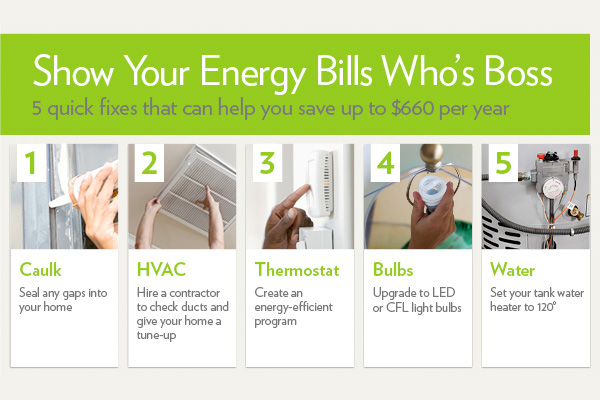
The 5 Things You Should Do to Show Your Bills Who’s Boss

1. Caulk and seal air leaks. Buy a few cans of Great Stuff and knock yourself out over a weekend, sealing penetrations into your home from:

  • Plumbing lines
  • Electricity wires
  • Recessed lighting
  • Windows
  • Crawlspaces
  • Attics

Savings: Up to $220 per year, says EPA

Related: The Biggest Air Leak in Your Home You Don’t Know About

2. Hire an HVAC contractor to take a hard look at all your ductwork — are there any ducts leaking that need to be resealed? — and give you an HVAC tune-up.

Savings: Up to $330 per year, for duct sealing and tune up, says DOE

3. Program your thermostat. Shelton found that 40% of consumers in her survey admit to not programming their thermostat to energy-saving settings. She thinks it’s even higher.

Savings: Up to $180 per year, says EPA

Related: How to Program Your Thermostat to See Real Savings

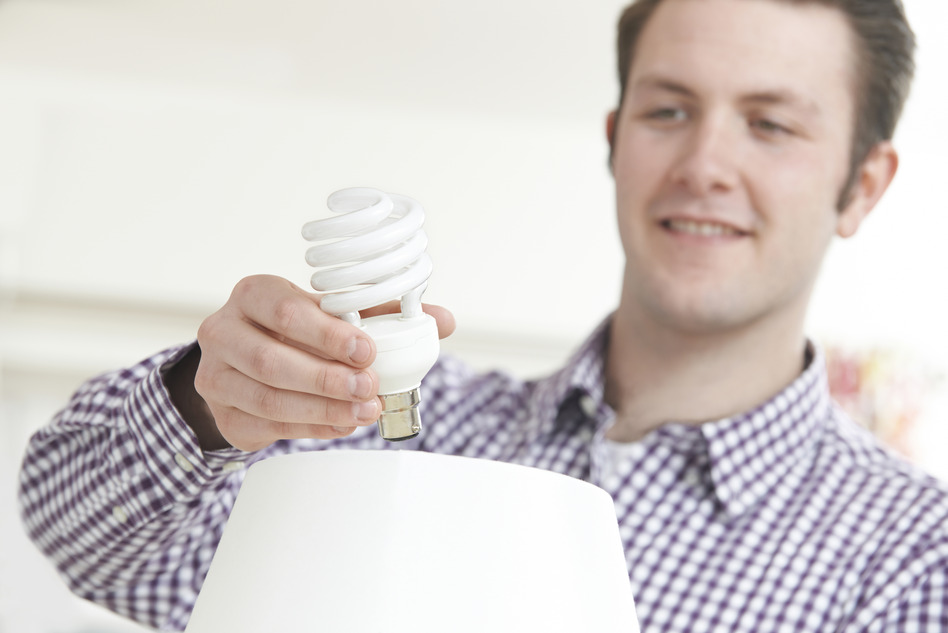
4. Replace all your light bulbs with LEDs or CFLs. We suggest LEDs, which have fewer issues than CFLs (namely, no mercury), and although expensive are coming down in price. We’ve even seen a $10 model.

Savings: $75 per year by replacing your five most frequently-used bulbs with Energy Star-rated models, says EPA.

Related: Guide to Buying Light Bulbs and Which to Use Where

5. Reduce the temperature on your water heater. Set your tank heater to 120 degrees — not the 140 degrees most are set to out of the box. Dropping 20 degrees could save 6% to 10% on your annual water heating costs, which are 14% to 18% of your utility bills. Also wrap an older water heater and the hot water pipes in insulating material to save on heat loss.

Savings: $18 to $39 per year

Important note: Resist the urge to total these numbers for an annual savings. The estimated savings for each product or activity can’t be summed because of “interactive effects,” says DOE. If you first replace your central AC with a more efficient one, saving, say, 15% on energy consumption, and then seal ducts, you wouldn’t save as much total energy on duct sealing as you would have if you had first sealed them. There’s just less energy to save at that point.

But these practices can help you achieve the goal of shaving 20% to 30% of your annual bill ($440 to $660).

Energy Savings is Addictive. What Else Can We Do?

If you want to go further and spend more, especially if you’re not planning to sell your home soon:

  • Add insulation. Anything you can do to shore up your building envelope is good.
  • If major appliances like your HVAC and water heater are nearing the end of their useful life, research energy-efficient replacements and keep the info where you’ll remember. Otherwise, you’ll make a reactive purchase when the unit finally breaks.
  • Contact your utility about rebates for investing in improvements. Or visit DSIRE, a database of federal, state, local, and utility rebates searchable by state. Energy Star has a discount and rebate finder, too.

A Final Word: Oh, Behave!

Remember the Snackwell’s effect? If your behavior — unplugging chargeable devices from the socket when they’re done charging; putting computers, TVs, and media on smart strips and turning them off at once; reprogramming your thermostat at daylight savings time — doesn’t support your improvements, you’re letting energy, an invisible product, win.

Related:

  • Trying to convince someone you live with to be more energy efficient? Here’s how to win the energy-savings argument.
  • Fun DIY Projects to Cut Energy Use


By: Christina Hoffmann:© Copyright 2015 NATIONAL ASSOCIATION OF REALTORS®
Why Fake Grass is Gaining Popularity

Why Fake Grass is Gaining Popularity

Want a picture-perfect lawn? Maybe fake grass is the answer. It solves watering, weeding, and fertilizing woes. But is it perfect?

If you live in a low-water area, or if you’re just tired of constant lawn maintenance, you’re in good company.

More homeowners are saving time, water — and their backs — by switching from real grass to artificial turf.

Synthetic grass for landscaping and recreation is growing 10% to 15% a year in the U.S.

That means more and more homeowners are using fakes for:

  • Lawns
  • Dog runs
  • Play areas
  • Pool surrounds
  • Rooftops
  • Putting greens
  • Decorative borders between patio pavers

Faking It is Right for You If:

  • You’re tired of watering, weeding, fertilizing, and cutting real grass.
  • Your summer water bills are too high.
  • You don’t want to use chemical fertilizers and herbicides.
  • You believe artificial grass looks as good as real grass — maybe better.

What Exactly is Artificial Grass?

Fake grass consists of filaments threaded into a backing that lets water through. The backing is laid on a drainage layer, usually compacted gravel, and fastened along the perimeter. Then it’s filled with recycled crumb rubber or sand to keep it from blowing away in a stiff breeze.

Today’s synthetic grass is made of nylon, polyethylene, or polypropylene that’s colored to look like various species.

Synlawn, one of the largest manufacturers of synthetic grass, offers: SYNBermuda, SYNFescue, SYNZoysia — you get the idea. Some grasses even have a thatch layer that makes a yard look less Stepford-like and more realistic.

Let’s Talk Money

Artificial grass comes with a big upfront cost — $5 to $20 per square foot, installed. Once it’s down, it’s free for the next 15 to 25 years.

Professionally laid sod, on the other hand, costs only 14 to 60 cents per square foot. But that’s where expenditures (and upkeep) begin. You’ve got to water, mow, fertilize — all of which cost money and take time.

Let’s crunch some numbers on a hypothetical 500-square-foot yard.

First year costs:

Artificial Grass
Installation ($12.50/sq. ft. average) $6,250


Natural Sod
Installation (37 cents/sq. ft. average) $185

Annual costs:

Artificial Grass
Watering n/a
Fertilizing n/a
Gardener/Lawn Man n/a
Annual Total: $0


Natural Sod
Watering ($15/month for 6 months) $90
Fertilizing (20 cents/sq. ft.) $100
Gardener/Lawn Man ($25/week for 26 weeks) $650
Annual Total: $840

So, it would take about seven years for maintenance-free artificial grass to recoup its initial cost. If you’re planning on staying put for longer than that, you’ll begin to save money each year.

What are the Good Points of Artificial Grass?

  • It saves water.
  • It’s easy to maintain.
  • Synthetic grass can be environmentally friendly.

The Southern Nevada Water Authority says a home owner saves 55 gallons of water per year for every square foot of natural grass replaced with synthetic. Plus, some water companies in drought-prone areas will offer a cash rebate for artificial grass, up to $1 per square foot.

You’ve got to blow off leaves and other debris, and hose off pet waste. But there’s no mowing, seeding, edging, and fertilizing — lawn maintenance chores that take the average home owner about 150 hours per year, says Ted Steinberg, author of “American Green: The Obsessive Quest for the Perfect Lawn.”

The Synthetic Turf Council says synthetic lawns’ recycled crumb rubber infill keeps 20 million rubber tires out of landfills every year.

What are the Drawbacks?

  • It’s not completely maintenance-free.
  • It can’t absorb and break down pet urine.
  • It heats up in direct sun.
  • It can’t be recycled.
  • Some HOAs and municipalities ban fake grass.

Weeds can still grow in the dust or rotted leaves that can accumulate; so, you’ll have to spend time blowing or raking.

If you don’t hose off pet runs regularly, they’ll stink.

It radiates heat to surrounding people, pets, trees, and buildings. Shade trees, which prevent real grass from growing, will prevent fake grass from getting too hot.

Although the industry is working on ways to recycle old synthetic grass, currently fakes end up in landfills.

Alternatives to Fake Grass

  • Low-Maintenance Turf Grasses
  • Natural Lawn Replacement Ideas

Or, if you want to green up your lawn in a hurry, try lawn paint.


By: Lisa Kaplan Gordon:© Copyright 2015 NATIONAL ASSOCIATION OF REALTORS®

Tips on Pool Fence Safety to Reduce Your Liability

Tips on Pool Fence Safety to Reduce Your Liability

There’s nothing more inviting on a hot summer day than a cool dip in the pool . And that can lead to trouble if your pool lacks a child-proof fence.

Installing a fence around your swimming pool is a smart security measure that prevents kids from having unsupervised access. In many areas, the law and your insurance company may also require it. But how do you know what kind of fence to pick?

Here’s where things get tricky.

There Are No Standard Requirements

The U.S. does not have a federal pool fence law. Instead, pool barriers are regulated at the state and local level.

Wait, it gets more complicated.

There are exemptions built into these laws. For example, families with children over 6 years old don’t have to install a pool fence in Arizona — unless you live in Scottsdale, Glendale, and several other areas.

See what I mean? It’s confusing.

Then you have to consider that although your pool might be exempt from fencing laws, your insurance company might require it.

So, what to choose?

Follow These Recommendations to Be Safe

Here’s a list of features every pool fence should have, based on legal requirements across the states and the U.S. Consumer Product Safety Commission:

  • Height: Some areas require a 4-ft. fence; the CPSC recommendation is 4 ft. or taller.
  • Structure: Must be impossible for children to climb.
  • Type: Permanent fencing is ideal because of durability.
  • Gate: All states require that they open outward away from the pool area, and be self-closing and self-latching.
  • Materials: Structures can be made from a wide range of stuff including wood, vinyl, and aluminum. However, make sure the material you pick is not easily susceptible to damage.

For more on pool safety, visit PoolSafely.gov.

The 3 Most Popular Types of Fences

1. Removable mesh pool fencing: Many consumers like this option because it’s an easy-to-move transparent barrier. But when it comes to safety, don’t skimp. The Association of Pool & Spa Professionals has set a standard for fences like these that is recognized worldwide. Here in the U.S., it has the approval of the American Society for Testing and Materials. So if you go with a mesh barrier, make sure it meets or exceeds the ASTM requirements. In many areas this is also mandatory by law.

2. Vertical bar fencing: Structures can be made from a wide range of stuff including wood, vinyl, aluminum, and wrought iron. However, make sure the material you pick is not easily susceptible to damage. In most states, the space between the vertical bars can’t be more than 4 inches wide.

3. Glass panel fencing: Barriers like these are very popular in California. They are durable and safe because they’re made from tempered glass. Plus, since they’re transparent, they don’t detract from your pool’s beauty.

Add Additional Protection

Keep in mind: Many states, such as New York and California, require layers of protection in addition to fencing.

Examples of additional layers of security include:

  • Automatic rigid pool covers
  • An underwater motion swimming pool alarm
  • Rescue equipment

But who do you contact in your area to get the skinny on swimming pool safety? Since every state and county sets up their agencies differently, try contacting the following departments in your area:

  • Building Code Department
  • Department of Health
  • Licensing and Regulatory Affairs


By: Deirdre Sullivan:© Copyright 2015 NATIONAL ASSOCIATION OF REALTORS®
Does a Pool Add Value to a Home?

Does a Pool Add Value to a Home?

Published: July 10, 2013

Learn how a pool affects the value of your home, and get advice on construction and maintenance costs.

Does a pool add value to a home? No. And yes.

In general, building a pool is not the best way to add value to your home. You’re better off making physical improvements to your actual house instead of adding a pool to your yard.

Related: What Home Projects Give the Most Value?

However, a pool can add value to your home in some cases:

  • If you live in a higher-end neighborhood and most of your neighbors have pools. In fact, not having a pool might make your home harder to sell.
  • If you live in a warm climate, such as Florida or Hawaii.
  • Your lot is big enough to accommodate a pool and still have some yard left over for play or gardening.

Still, that’s no guarantee you’ll get a return on your investment. At most, your home’s value might increase 7% if all circumstances are right when it comes time to sell. Those circumstances include the points made above, plus:

  • The style of the pool. Does it fit the neighborhood?
  • The condition of the pool. Is it well-maintained?
  • Age of the pool. If you put a pool in today and sell in 20 years, you probably won’t recoup your costs, especially if the pool needs updating.
  • You can attract the right buyer. Couples with very young children may shy away from pools because of safety issues, but an older childless couple may fall in love with it.

But only you, the homeowner, can determine the true return on investment. A pool can add value to your quality of life and enhance the enjoyment of your home. You can’t put a price tag on that.

But we can put a price tag on how much a pool costs to build and maintain.

The Cost to Build a Pool

The average cost in the U.S. to install, equip, and fill a 600-sq.-ft. concrete pool starts at $30,000.

Add in details like safety fences (most states require them), waterfalls, lighting, landscaping, and perhaps a spa, and you’re easily looking at totals approaching $100,000.

Costs also depend on the type of pool you choose.

Gunite is the most popular in-ground pool. Gunite is a mixture of cement and sand, which can be poured into almost any shape. It has replaced concrete pools as the sought-after standard.

Fiberglass shells and those with vinyl liners fall on the lower end of the budget scale, but the liners typically need replacing every 10 or so years. Changing the liner requires draining the pool and replacing the edging (called coping), so over time, costs add up. Most homebuyers will insist that you replace a vinyl liner, even if it’s only a few years old.

Related: Fences for Pool Safety

Filtration and Heating

The filtration pump is the biggest energy hog in a pool system, so you want to get the most efficient pump possible. The good news here is that new, variable-speed pumps use up to 80% less energy than old single-speed pumps, cutting operating expenses dramatically.

At about $500, these cost more up front, but some local utilities offer rebates through participating pool dealers. You can further cut energy costs by setting the pump to run at non-peak times, when rates for electricity are lower.

If you’re planning to heat your pool, gas heaters are the least expensive to purchase and install, but they typically have the highest operation and maintenance costs. Many pool owners opt instead for electric heat pumps, which extract heat from the surrounding air and transfer it to the water. Heat pumps take longer than gas to warm the pool, but they’re more energy-efficient, costing $200 to $400 less to operate per swimming season.

Regardless of heating system, covering the pool with a solar blanket to trap heat and reduce evaporation will further lower operating costs.

Related: Solar Pool Heater Costs and Facts

Maintenance Expenses

All pools require that the water be balanced for proper pH, alkalinity, and calcium levels. They also need sanitizing to control bacteria and germs, which is where chlorine has traditionally entered the picture.

These days you have a variety of options, including systems that use bromine, salt, ozone, ionizers, or other chemical compounds that can be less irritating to skin. Chlorine remains the most popular because the upfront costs are reasonable, and you don’t have to be as rigid about checking the levels on a set schedule. But as far as your wallet is concerned, they all even out in the end.

In a seasonal swimming climate, budget about $600 annually for maintenance if you shoulder the chemical balancing and cleaning yourself; in a year-round climate, it’s more like $15 to $25 per week.

To save yourself the task of once-a-week vacuuming, you can buy a robotic cleaning system for between $500 and $800 that will do the job for you. In locations where the pool must be opened and closed for the season, add another $500 each time for a pro to handle this task.

Related: Natural Swimming Pools

Insurance and Taxes

A basic homeowners insurance policy typically covers a pool structure without requiring a separate rider, but you should increase your liability from the standard amount.

It costs about $30 a year to bump coverage from $100,000 to $500,000. Many underwriters require you to fence in the pool so children can’t wander in unsupervised.

In some areas, adding a pool may increase your annual property taxes, but it won’t necessarily add to your home’s selling price. For that reason, try to keep your total building cost between 10% and 15% of what you paid for your house, lest you invest too much in an amenity that won’t pay you back.


By: Julie Sturgeon:© Copyright 2015 NATIONAL ASSOCIATION OF REALTORS®

 

The owner of this website has made a commitment to accessibility and inclusion, please report any problems that you encounter using the contact form on this website. This site uses the WP ADA Compliance Check plugin to enhance accessibility.