The Housing Market Is on Solid Ground, Even with More Foreclosures

The Housing Market Is on Solid Ground, Even with More Foreclosures Simplifying The Market

It’s been nearly two decades since the 2008 housing crash, but the word “foreclosure” can still make people uneasy. And if you’re planning a move, you may be wondering if more foreclosures will flood the market with homes for sale – especially if you’ve seen the headlines lately.

Buyers may be hoping for a rush of bargains. Sellers may be bracing for more competition. The latest data points to neither, and knowing why can help you plan your next move with confidence.

A Modest Rise from a Low Starting Point

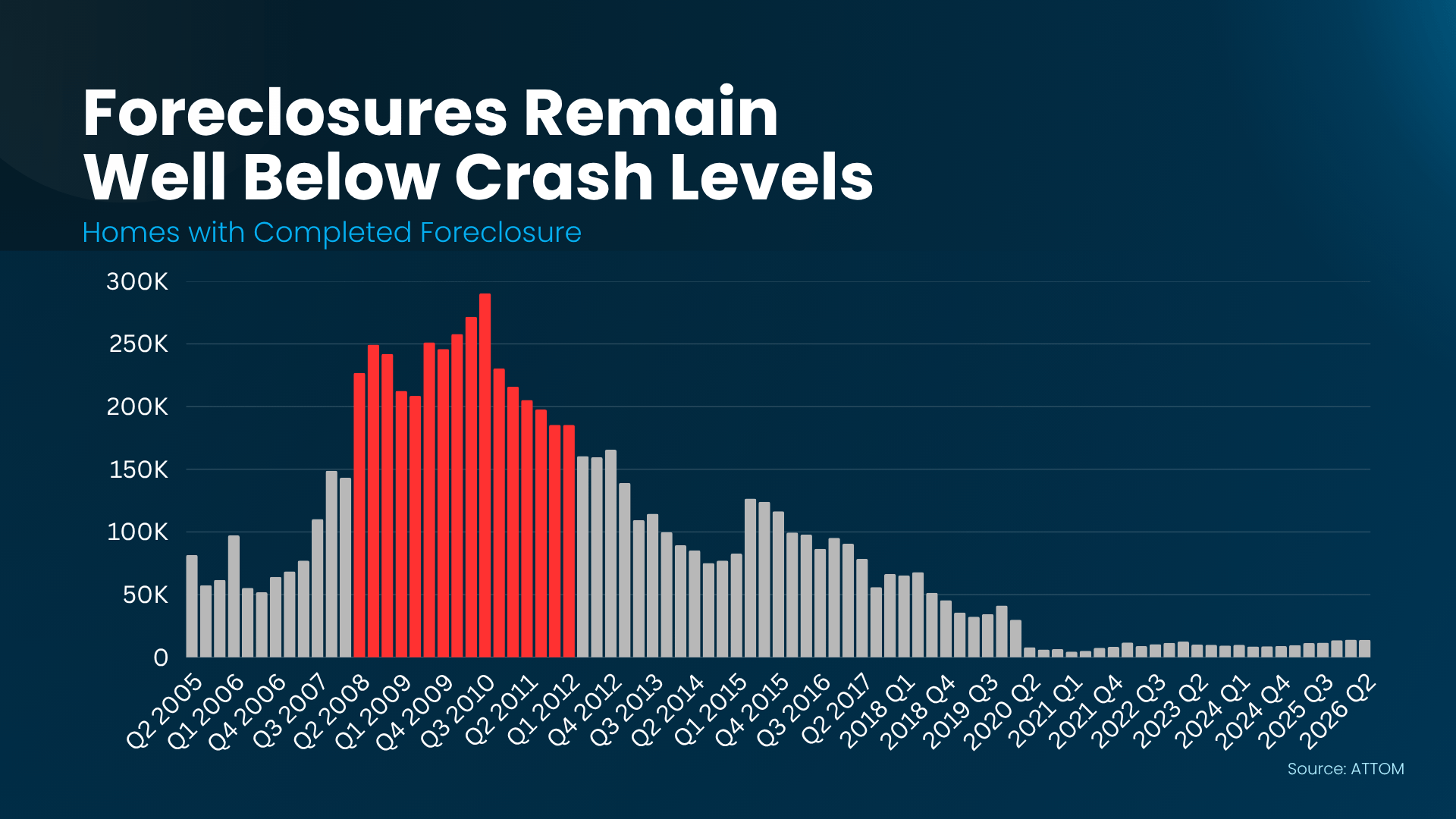
Completed foreclosures are up 33% from last year, according to ATTOM. That sounds like a big leap, but context helps.

Even with that increase, foreclosures are still about 26% below where they were in the first half of 2020.

Zoom out further, and today’s activity is a small fraction of what the market saw during the 2008 crash. Lenders completed about 28,000 foreclosures in the first half of 2026, according to ATTOM. Compare that to the crash years in red, when lenders often completed more than 200,000 in the span of a few months (see graph below):
a graph of a crash

Experts say today’s numbers reflect a housing market that’s still in good shape. As Rob Barber, CEO at ATTOM, explains:

“While some homeowners are still facing financial challenges, overall foreclosure volumes remain well below historical norms and the broader housing market continues to demonstrate resilience.”

And here’s why we can absorb the slight uptick in foreclosures we are seeing. 

Homes for Sale Are Back in a Balanced Range

During the crash, a lot of homeowners either lost their homes to foreclosure or were forced to sell, which left the market overwhelmed with houses for sale. That isn’t happening now.

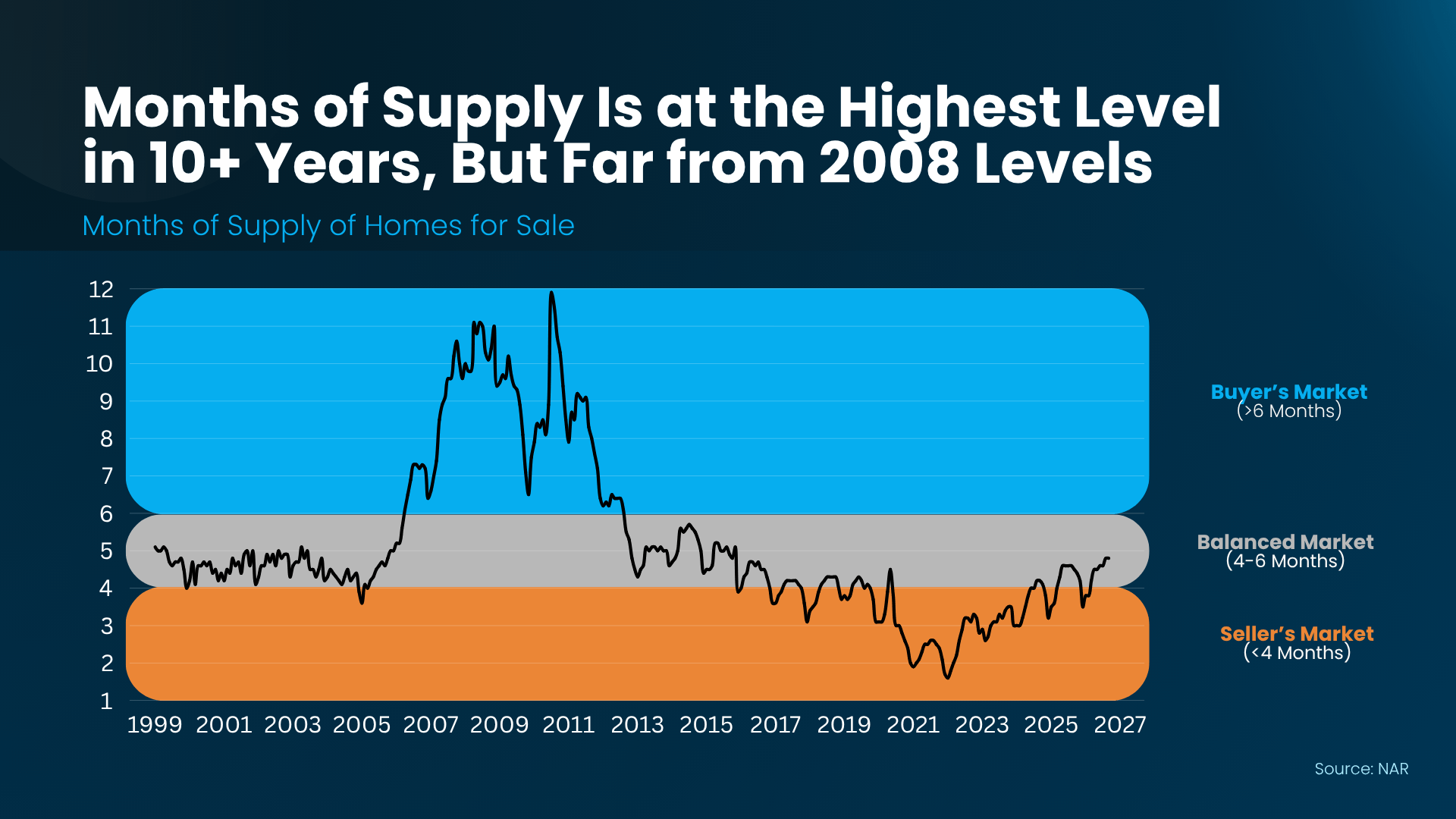
One way to see this is through months’ supply, which measures how long it would take to sell every home on the market at the current pace. Four to six months is considered balanced.

Right now, it’s about 4.8 months, according to the National Association of Realtors (NAR). That’s pretty well-balanced, and less than half of where it peaked around the last crash (see graph below):
a graph of a graph of a graph of a graph of a graph of a graph of a graph of a graph of a graph of a graph of a graph of a graph of a graph of

If foreclosures were really surging, you’d see it in the number of homes for sale. As Logan Mohtashami, Lead Analyst at HousingWire, explains:

“. . . a surge of actual foreclosures in 2026 would have easily put the inventory data much higher in 2026.”

Equity Gives Today’s Homeowners Options

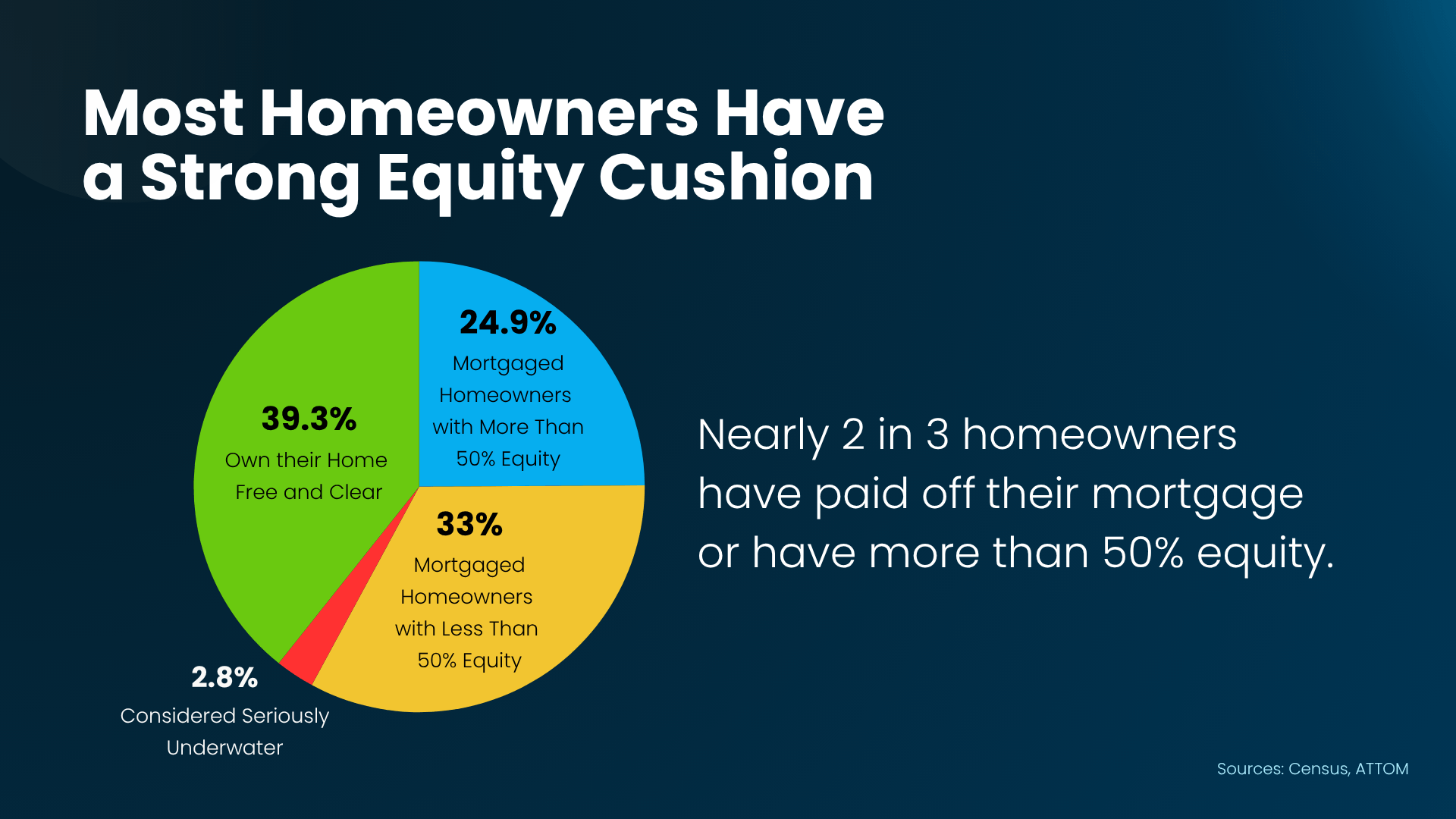
Equity is a big reason there’s no surge of distressed sales. Data from the Census Bureau and ATTOM shows nearly two in three homeowners have paid off their mortgage or have more than 50% equity. And Cotality says the average homeowner has about $310,000 in equity.

If a homeowner with equity hits a rough patch, they can usually sell their house, pay off the loan, and walk away with money in their pocket instead of facing foreclosure. That’s an option many people didn’t have during the crash. According to HousingWire, nearly one in four homes were underwater back in 2010.

Being underwater means owing more on your mortgage than your home is worth, which makes selling a lot harder. Today, just 2% of homeowners are considered seriously underwater (see graph below):
a pie chart with text on it
Not every homeowner has that kind of equity, but most do, and that’s what puts a ceiling on how high foreclosures can go.

Bottom Line

If rising foreclosures have you questioning where the housing market is headed, the data says it’s in good shape. The supply of homes for sale is balanced, and most homeowners have plenty of equity.

Have questions about what you’re seeing online, your local market, or about how much equity you have? Talk to a local real estate agent.


Today’s Market Could Be a Win for Veterans Looking To Buy a Home

Today's Market Could Be a Win for Veterans Looking To Buy a Home Simplifying The Market

If you’re a veteran or active-duty service member who’s been hoping to buy a home, you may have more going for you in today’s housing market than you realize.

VA home loans already come with some pretty powerful benefits. But now, with more homes for sale and buyers having more room to negotiate in many markets, those benefits could go even further.

And if you’ve ever heard that buying with a VA loan is harder, takes longer, or puts you at a disadvantage, there’s something else you should know… a lot of what people believe about VA loans simply isn’t true.

The Benefits of VA Home Loans 

Today, nearly 4 million service members and veterans have an active VA home loan. And according to the Department of Veterans Affairs (VA), more than 343,000 homes were purchased using VA loan benefits in its most recent reported fiscal year. And it’s easy to see why.

For eligible veterans and service members, VA loans offer advantages that can make buying a home more affordable, including:

  • No down payment required for many eligible borrowers.

  • No monthly mortgage insurance, even with no down payment.

  • Competitive mortgage rates that can help lower monthly payments.

a blue and white website with text

Benefits like this are powerful in any market – and even more so today. That may be why VA loan usage has grown for the last two years in a row.

Why Today’s Market Could Be Different for VA Buyers

A few years ago, when homes were getting multiple offers and buyers were competing for nearly every listing, VA buyers sometimes had a harder time getting their offers accepted.

A 2021 survey from the National Association of Realtors (NAR), found 89% of sellers were likely to accept an offer from a buyer using a conventional loan. But only 30% were likely to accept one using an FHA or VA loan.

The reason? Some sellers were concerned that VA financing would take longer, be more difficult to close, and require them to pay more in costs and repairs. But those concerns don’t necessarily reflect how VA loans actually perform.

VA Home Loan Myths vs. Reality 

A white paper from Vetted VA based on 2025 mortgage data busted a lot of VA loan myths:

Myth #1: VA loans get denied more often than other loans.

  • The Reality: VA loans actually have the lowest denial rate. Just 8.2% of VA purchase applications were denied, compared to 15.0% for conventional loans, 12.8% for FHA loans, and 12.5% for USDA loans. 

Myth #2: VA financing is less reliable.

  • The Reality: 90% of VA home loan applications that reached underwriting made it to closing, compared to 81% for conventional loans. 

Myth #3: VA appraisals take longer.

  • The Reality: VA loan appraisals typically take 7–10 business days, similar to conventional and FHA loans.

Myth #4: Sellers have to pay all the closing costs for VA buyers.

  • The Reality: VA buyers can pay many standard closing costs themselves. Buyers and sellers can also negotiate which eligible costs the seller will cover.

Today’s Market Gives VA Buyers More Leverage

Since there are more homes for sale and fewer buyers competing in many areas, sellers may be more open to different financing options than they were a few years ago. And the opportunity doesn’t stop at getting your offer accepted.

Depending on the house and your local market, you may also be able to negotiate a lower price, ask for repairs, or request help with closing costs.

VA guidelines allow sellers to cover the buyer’s normal closing costs, plus concessions of up to 4% of the home’s value.

Think about what that combination could mean. You may be able to buy with no down payment, avoid mortgage insurance, and negotiate help with some of the other expenses that come with buying a home.

That could mean keeping thousands of dollars in your savings instead of spending them upfront, giving you more breathing room after you get the keys.

Bottom Line

If you’re active duty, you’ve served, or you know someone who has, connect with a local agent and a trusted VA-approved lender to see what you qualify for.

Your VA home loan benefit and today’s market could be a powerful combination.

Low Rates or Lots of Leverage? Buyers Rarely Get Both.

Low Rates or Lots of Leverage? Buyers Rarely Get Both. Simplifying The Market

If you’ve been watching mortgage rates lately, you might feel a little stuck. Rates climbed above 7% this year, and a lot of buyers have decided to sit tight and wait for them to come back down.

But rates are only half the story. When you buy a home, you usually get one of two things: low rates or negotiating power. It’s rare to get both at the same time. And right now, you have a lot more of that second one than you might think.

Why Low Rates and Leverage Don’t Usually Show Up Together

Think back to 2020 and 2021. Rates were near 3%, and buyers rushed into the housing market. Those low rates sounded great, but they came with a catch. There were a lot of buyers just like you that you had to compete with – and there weren’t enough homes for sale to meet that demand. 

That’s why homes got multiple offers, buyers paid over asking or waived inspections, and sellers held all the cards. Jake Krimmel, Senior Economist at Realtor.com, shows just how one-sided things got:

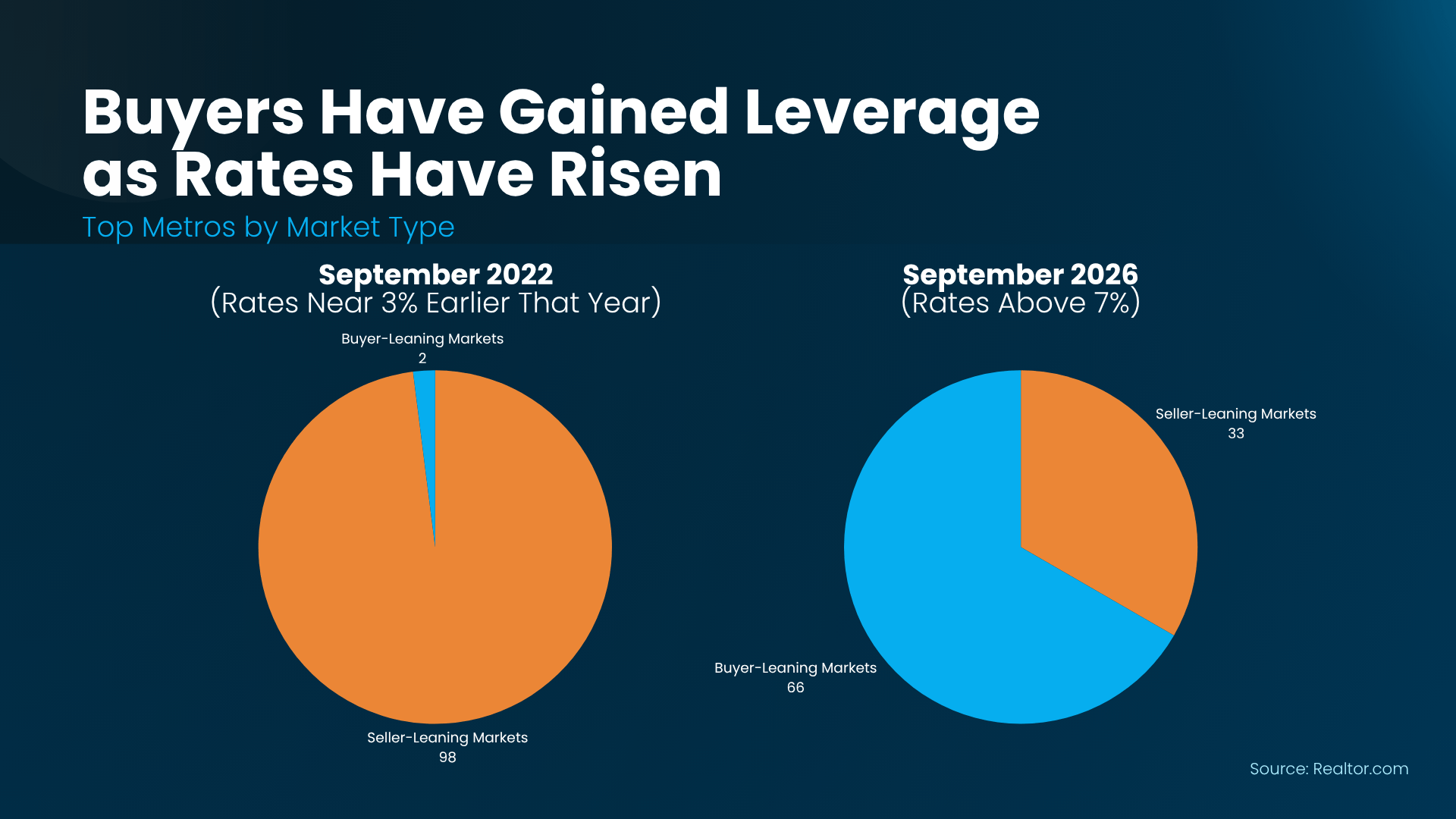
“Seller’s markets peaked at 98 of 100 metros in spring 2022 after two years of mortgage rates near 3%.”

Then, in the second half of 2022, rates went up. As a result, the number of people buying homes went down, inventory grew, and the balance slowly started tipping from sellers back to buyers. Fast forward to today, and that flip is officially here. 

In a recent report, Realtor.com found about two-thirds (66) of the top 100 metros now lean in favor of buyers (see graph below):

a blue and orange pie chart

And while you may want lower rates, this shift in power has its own perks.

What Your Leverage Looks Like Right Now

There are more homes for sale than there have been in years. And in a more buyer-friendly market like that, it means sellers have to work harder to get their homes sold. As Lawrence Yun, Chief Economist at the National Association of Realtors (NAR), says:

“Higher inventory and lengthening days on market give buyers improved negotiating power.”

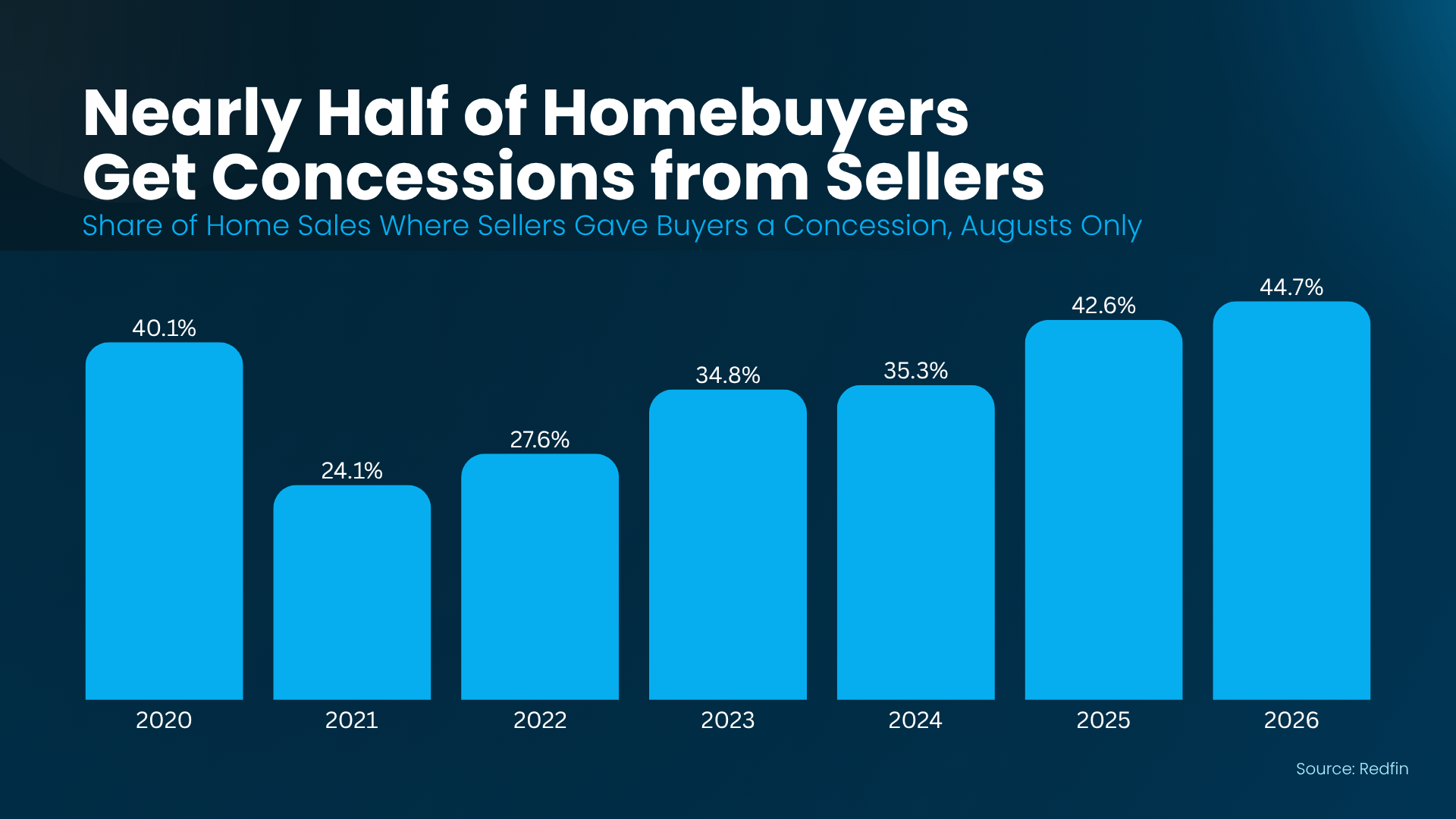
That shows up in the deals buyers are getting. According to Redfin, nearly half of buyers now get some kind of concession from the seller – like help with closing costs, money for repairs, or even the seller paying to buy down your mortgage rate (see graph below):

a graph of sales growth

So when you find a home you love, even if the rate isn’t what you necessarily wanted, there are other levers to pull. Ask about a price cut or a seller-paid rate buydown, too. It could take some of the sting out of today’s rates.

Why Waiting for Lower Rates Could Backfire

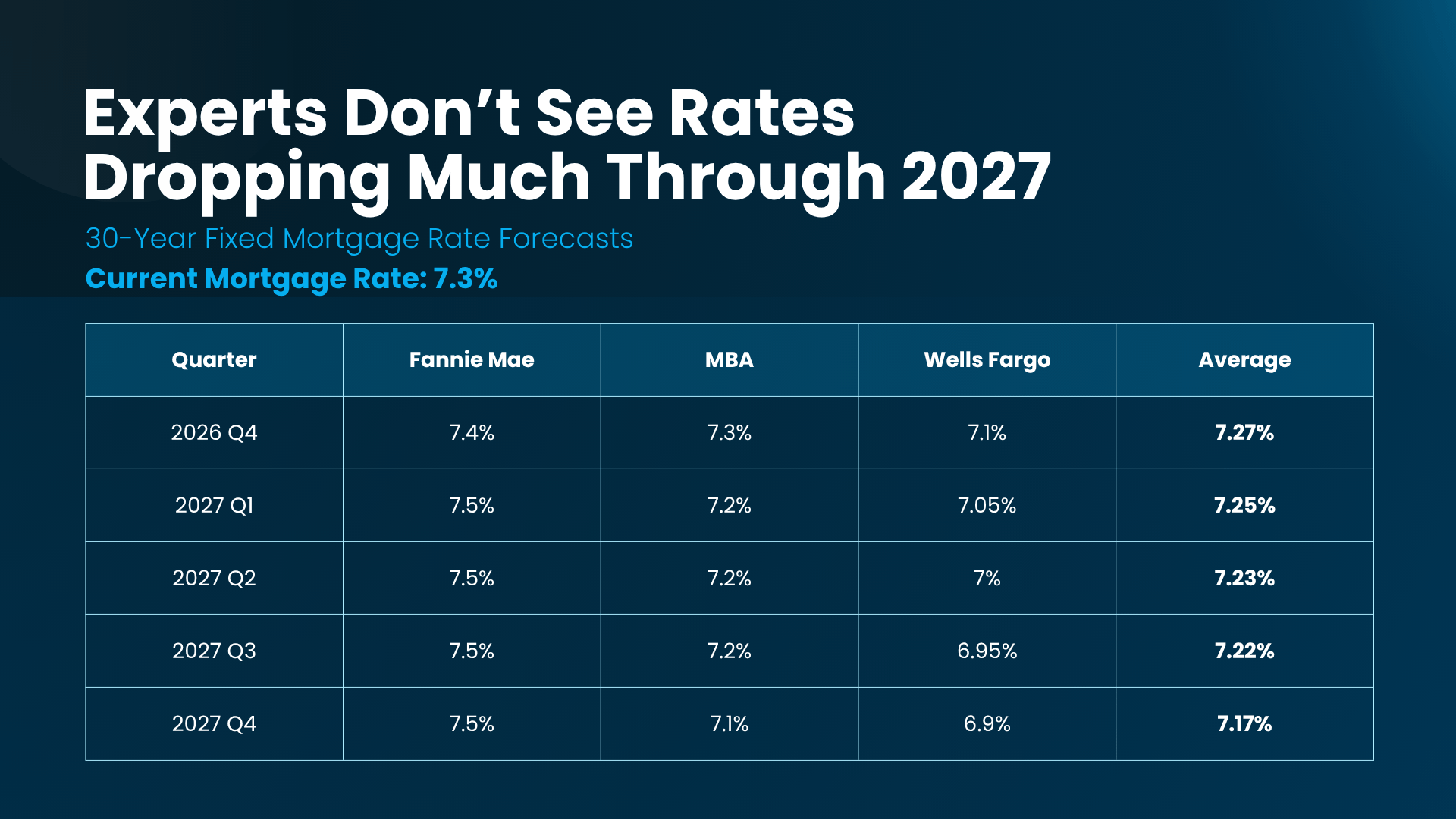
And just in case you’re still thinking you’ll just hold off until rates drop, here’s what you should know. Experts at Fannie Mae, the Mortgage Bankers Association (MBA), and Wells Fargo don’t expect rates to fall much through 2027 (see graph below):

a blue and white graph with white text

And here’s the whole point. Even if rates did drop in a big way, a lot of buyers would rush back in. More competition means fewer deals, fewer concessions, and sellers getting the upper hand again.

So waiting comes with a trade-off. You might land a better rate down the road, but you’d probably give up the bargaining power you have today.

That doesn’t mean you have to move right now. You should only buy when the numbers work for you. But if you’ve got a real reason to move, today’s leverage could help make your numbers work – even at today’s rates.

Bottom Line

Buyers rarely get low rates and strong negotiating power at the same time, and today’s market is handing you the leverage. 

Connect with a local real estate agent to find homes where sellers may be open to covering a rate buydown or closing costs, so you can see if today’s market can work for your budget.

Selling Your Home? What You Should Know About Price Cuts vs. Rate Buydowns.

Selling Your Home? What You Should Know About Price Cuts vs. Rate Buydowns. Simplifying The Market

In today’s market, a growing number of sellers are opting to do something called a price cut – especially when their house has been on the market for a while without any bites.

According to HousingWire Data as many as 4 in 10 (43%) sellers are going this route – that’s the highest it’s been in 4 years. But what if there’s another (potentially better option) for your bottom line? And it’s just as appealing, if not more so, to today’s buyers?

Enter the rate buydown.

Why Buyers Expect a Deal

First, let’s set the stage on why some compromise may be necessary in today’s market.

In September, Redfin says there were 63% more sellers than buyers in the market. And with so many sellers active and relatively few buyers by comparison, those purchasers are realizing they have more power. And as mortgage rates continue to put a squeeze on their budgets, they’re leaning in and using it.

One of the most common negotiation points? The price.

That’s because they want to feel like they’re getting a deal and they want to see their monthly payment drop. And since buyers can’t control rates, the price feels like the most obvious lever to pull.

But the savviest sellers realize being flexible doesn’t always mean a lower price, paying for a buyer’s rate buydown might work better.

What Is a Rate Buydown?

A buydown is money paid at closing to lower the buyer’s mortgage rate. When you pay it as the seller, you are paying some of the buyer’s interest ahead of time, so the buyer gets a lower rate and monthly payment. And that’s especially appealing to today’s buyers.

  • Temporary buydowns lower the rate for the first few years, then it goes back to the full rate. The more years a buydown covers, the more it costs. These work well for buyers who expect to refinance within a certain amount of time.

  • A permanent buydown lowers the rate for the whole loan. These are paid for with “discount points.” One point costs 1% of the loan. According to FICO, each point generally lowers the rate by about a quarter of a percent. This type of buydown works well for buyers who plan to stay in the home for a long time.

Same Money, Different Results

And here’s why these can be a win-win for both buyers and sellers. Rate buydowns help sellers stand out in a crowded market and they can have a bigger impact on your buyer than a price cut would.

Here’s an example to show you what that could look like. 

Let’s say you’re willing to make a $10,000 concession to help get the deal done. Take a look at these three ways to spend that money and the impact they could have on a buyer’s $420,000, 30-year fixed loan at 7%:

It’s the same $10,000 from the seller. But a 2-1 buydown saves the buyer about eight times more each month in the first year.

And since most buyers shop by monthly payment, that’s what grabs their attention.

That’s what makes a rate buydown worth considering. Instead of reducing your asking price, you may be able to use that same money to have a bigger impact on your buyer’s monthly payments. And depending on what matters most to that buyer, the immediate savings could be more appealing than a price reduction.

The key is working with your agent and the buyer’s lender to compare the options and see which one makes the most sense.

Things To Know

  • Loan programs cap how much a seller can pay toward a buyer’s costs. 

  • Money toward buydowns doesn’t limit what else a buyer may ask a seller to pay for. Buyers may still ask for repairs or other concessions.

  • Putting the buydown offer in your listing lets agents and buyers know it’s an option.

  • Your agent can run scenarios on buydowns and other costs of selling in advance so you’re prepared when an offer comes in.

As Lawrence Yun, Chief Economist at the National Association of Realtors (NAR), says:

“Home sellers need to be realistic about local market conditions, which could require price discounts and other incentives to attract buyers.”

And sellers who offer solutions like buydowns can make meaningful impact where home buyers need it most: in their wallets.

Bottom Line

When you’re looking for ways to make your house more appealing to buyers, a price reduction isn’t your only option. A mortgage rate buydown could help a buyer save more each month, especially in the early years of their loan.

Talk to your agent or a trusted lender which incentives could make the biggest difference for buyers in our market, while still protecting your bottom line.

What the Silver Tsunami Means if You’re Planning To Sell

What the Silver Tsunami Means if You’re Planning To Sell Simplifying The Market

If you’re following the housing market, you may have heard the term “silver tsunami” lately. It’s the idea that millions of homes owned by older Americans could come onto the market as more homeowners reach retirement age and make their next move.

And when you hear a phrase like that, it’s easy to picture a flood of houses hitting the market all at once. But that picture doesn’t match the data.

This isn’t expected to happen overnight. 

And if you’re planning to sell, it’s not a reason to put your plans on hold. Let’s look at what the research actually says.

The Silver Tsunami Will Be More of a Gradual Shift

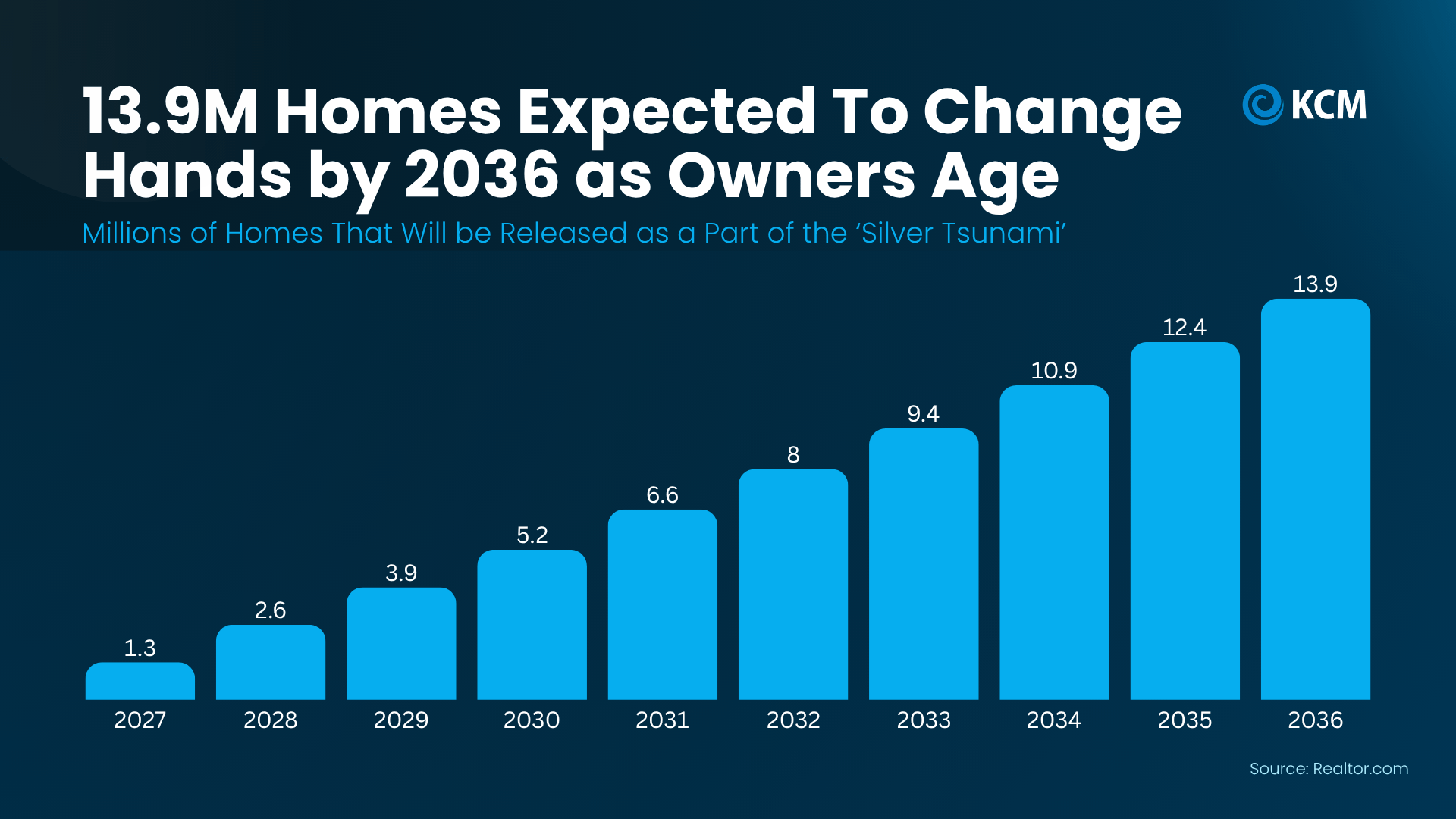
According to Realtor.com, about 13.9 million homes owned by older Americans are expected to change hands by 2036. Sure, that’s a big number. But these homes aren’t all expected to come onto the market at once.

The projections show this happening gradually over the next decade, with roughly 1.3 to 1.5 million homes changing hands each year (see graph below):

a blue graph with white text

Rather than a sudden wave of houses flooding the market, this is a gradual shift as longtime homeowners make decisions about where and how they want to live.

The term silver tsunami makes for a dramatic headline, but the actual data tells a much less dramatic story. And there’s another reason these homes won’t overwhelm the market.

The Market Has Room for More Homes

After the 2008 housing crash, builders significantly slowed construction. And for years afterward, they didn’t build enough homes to keep up with demand. That led to a housing shortage we’re still dealing with today.

And just how big a gap are we talking about? Estimates vary, but many experts say the U.S. is still millions of homes short. For example, a recent report from the White House Council of Economic Advisers explains:

“If homebuilding and the growth of the single-family housing stock had continued at their historical pace instead of falling dramatically after 2008, there would be 10 million or more additional single-family homes today.”

As more longtime homeowners sell, those homes will help a gap that’s already there. But they won’t push us over the edge. That’s because, at the same time, more households are expected to form in the decade ahead, and they’ll need homes, too. 

So, more homes becoming available over time isn’t automatically a bad thing. It can give buyers more options and help create a more balanced housing market moving forward.

What Actually Matters When You Sell

Here’s the takeaway if you’re thinking about selling your house. The silver tsunami isn’t something you need to plan your move around. What’s happening in your local market is far more important than a national projection about the next decade.

That’s because real estate is local. Some markets have more homes for sale than others. Some are seeing houses sell relatively quickly, while others are taking longer.

And those are the conditions that matter when you’re deciding how to price, prepare, and market your house.

For example, an agent who knows your area can help you understand:

  • How many homes are for sale nearby. This tells you how much choice buyers have and how your house will compare.

  • What similar houses are actually selling for. That’s one of the most important factors in setting a competitive asking price.

  • What buyers are looking for right now. Knowing which features and improvements matter most can help your house make a strong first impression.

And that’s something you can act on today, regardless of what happens with the silver tsunami over the next decade.

The right strategy starts with understanding your local market and making decisions based on what’s happening there, not what a dramatic national headline suggests might happen years from now.

Bottom Line

The silver tsunami may sound like a major wave of homes coming onto the market, but the research points to a gradual shift over the next decade, not a sudden flood of listings.

If you’re thinking about selling, don’t let that headline make you second-guess your plans. Talk to an agent about what’s happening in your local market.

The owner of this website has made a commitment to accessibility and inclusion, please report any problems that you encounter using the contact form on this website. This site uses the WP ADA Compliance Check plugin to enhance accessibility.