Have You Seen Your Refi and Mortgage Options Lately?

Have You Seen Your Refi and Mortgage Options Lately?

Published: April 8, 2013

Three good reasons to warm up to a refinance this spring.

Low interest rates and new loan programs abound this spring, so if you assumed your refinancing and mortgage options were dismal, you’ll be surprised by these three offerings.

1. Refinance with new FHA fees

In a nutshell: FHA raised insurance premiums for new borrowers, while lowering fees for some existing customers who refinance, making comparison shopping with private mortgage insurance worthwhile. Mortgage insurance covers the lender against losses caused when borrowers stop making payments.

The details: FHA’s new insurance premium rates include a great deal for existing FHA borrowers — you can refinance by paying a miniscule .01% upfront fee and an annual premium of just .55% if you got your original loan on or before May 31, 2009.

The catch: The deal is only for home owners who got their FHA mortgage on or before May 31, 2009.

The latest FHA deal for new FHA customers buying homes isn’t nearly as sweet. You’ll pay a whopping 1.75% upfront fee and an annual premium of 1.35% — more if your loan is more than $625,500. For a $200,000 loan, that’s $3,500 for the upfront premium payment and $2,700 for the annual premium.

If you can meet the tougher underwriting and higher downpayment rules of private mortgage insurance companies, check to see what that would cost for your  specific loan and location using calculators from such sources as MGIC, Radian, or Genworth Financial. Use the calculators to check how your payment would change depending on how much equity you have in your home.

2. Refinance underwater mortgage

In a nutshell
: If you owe more than your home is worth, you may finally be able to refinance into a lower rate thanks to the government’s HARP refinancing program.

The details: You can take advantage of historically low interest rates by using the latest version of the Home Affordable Refinance Program, which removed a previous cap on how far below your mortgage your home value can be.

The HARP program even works if you’ve been hit by the economic double-whammy of a falling family income and a falling home price. You qualify for a HARP refinance if:

  • You have income coming in.
  • You’ve made your mortgage payments on time every month for the past six months and have no more than one late payment in the past year.

The catch: Banks can layer their own tougher rules on top of the HARP requirements, and they’re not obligated to let you use the program to refinance your existing loan.

3. Refinance rental properties

In a nutshell: Some real estate investors have new loan options for the first time in years.

The details: In recent years, small landlords like me have had a tough time finding a bank to finance more rental property purchases. Once you had more than four rental property loans, Fannie Mae and Freddie Mac were no longer willing to guarantee your loans, even when your credit scores were top-notch and the property was able to turn a profit from day one of ownership.

Now, some banks participating in the HARP program are taking applications from landlords with multiple properties and lots of mortgages. HSBC recently agreed to look at a mortgage on a property I own in Baltimore. My current interest rate there is over 7% and if I get the HARP refinance it will fall to 4.6%.

It’s too soon to say whether the banks will actually fund me or any other landlord who wants to refinance.

The catches

  • Only Fannie Mae has made this change. (It’ll purchase up to 10 loans from any one investor.) Freddie Mac is still limiting single-family landlords to four loans.
  • Most banks discount your rental income by 25% when making investor loans, which adds up when you have multiple properties.

But, the fact that banks are accepting applications from rental property owners is a sign the credit spigot may be reopening for creditworthy real estate investors.

Are you shopping for a refinance or a mortgage to purchase a home? What’s your experience been like?


 

By: Dona DeZube © Copyright 2015 NATIONAL ASSOCIATION OF REALTORS®

Help for Homeowners Who Are Behind on Mortgage Payments

Help for Homeowners Who Are Behind on Mortgage Payments

The Making Home Affordable program offers at-risk homeowners a chance to modify mortgages to avoid foreclosure on their homes.

If you’re behind on mortgage payments (or about to be), which is putting you at risk of foreclosure, the Home Affordable Modification Program (HAMP) could be your lifeline.

Making Home Affordable, the federal program aimed at aiding struggling home owners, offers two options: refinancing (known as HARP) and loan modification, which this article explains.

Unlike refinancing, HAMP pays your current lender to rework your existing loan terms to lower your monthly payments.

But don’t expect to breeze through the qualifying process. You’ll need a lot of documentation and patience.

Qualifications for HAMP

  • Your home must be your primary residence.
  • You must owe $729,750 or less on a first mortgage that was originated on or before Jan. 1, 2009.
  • You must also demonstrate financial hardship — such as a jump in mortgage payments or a drop in income.

A loan modification makes sense if you can’t afford your current mortgage payment but could manage to stay current if your monthly payment were lowered. Homes of up to four units are eligible, with higher loan limits, as long as you occupy one of the units. HAMP is scheduled to expire at the end of 2015.

If you’ve failed at a prior loan modification, you may still apply for HAMP, so don’t let an earlier bad experience deter you from applying again.

The First Steps to Getting a Loan Modification

HAMP begins with a trial phase. Contact your lender to initiate the process, or call 1-888-995-HOPE to get free assistance from a housing counselor approved by the U.S. Department of Housing and Urban Development.

The lender will calculate a lower monthly payment, which you must make on time for at least three months. After successfully completing the trial phase, your lender should make the loan modification permanent.

While lenders may accept some undocumented information up front to begin the process, eventually you’ll need to file detailed paperwork to earn a permanent modification. It’s better to get your documentation ready in advance. HAMP administrators say the leading reason trial modifications fail to be made permanent is missing paperwork. 

Start by gathering paperwork on:

  • Your income (pay stubs)
  • Expenses (mortgage statements, tax and insurance bills, debt balances)
  • Assets (bank and non-retirement savings statements)

You’ll need that information to fill out the Request for Modification and Affidavit.

You also need to complete IRS form 4506T-EZ, which allows your lender to review your income tax returns.

File a Hardship Affidavit as well.

If possible, send all documents together in one package by certified mail to your lender. That will lessen the likelihood of lost paperwork and delays, says Nicole Hall, editor of LendingTree.com.

How Your Mortgage Payments Get Lowered

A lender can modify a mortgage in several ways:

  • Lower your interest rate
  • Reduce your principal
  • Extend the term of the loan

The basic goal is to use one or more of these approaches to get your monthly mortgage payment, including real estate taxes and homeowners insurance premiums, down to a more affordable payment. Lenders are allowed to cut your interest rate to as low as 2%, if necessary. The average HAMP modification has reduced monthly payments by $546.

To get a ballpark figure of how much a modification might lower your monthly payment, run the numbers for yourself. If, for example, your current mortgage payment is $2,000 and your monthly gross income is $4,000, then you’re paying 50% of your pre-tax income toward the home loan. A typical modification to bring that figure down to 31% would reduce the payment to $1,240, a savings of $760 a month.

If You’re Already Facing Foreclosure

Even if you’re already facing foreclosure, HAMP is worth a shot. The foreclosure process is suspended while you’re in the trial phase of the modification.

Foreclosure can be avoided altogether if you can demonstrate the ability to keep up with the new, lower payment and graduate to a permanent modification. Keep in mind that the foreclosure process can resume if you miss payments during the trial phase or fail to get approved for a permanent modification.

Some owners won’t be able to stay in their homes, even with a mortgage modification. To avoid foreclosure, look into the federal Home Affordable Foreclosure Alternatives program.

HAFA offers lenders financial incentives to opt for a short sale or deed-in-lieu rather than a foreclosure. 

In a short sale, a borrower sells a home for less than the outstanding mortgage, and the lender takes the proceeds and considers the debt paid off. In a deed-in-lieu, the homeowner turns over the home to the lender, and the mortgage is closed. Although neither option is ideal, either can make sense if a loan modification isn’t attainable or sufficient.


By: Donna Fuscaldo © Copyright 2015 NATIONAL ASSOCIATION OF REALTORS®


Want to Refinance Your Mortgage But You’re Being Turned Down?

Want to Refinance Your Mortgage But You’re Being Turned Down?

The federal program HARP might be able to help you. Here’s how it works.

Is your mortgage rate above today’s rates?

Is your house worth less than your current mortgage amount?

Are you unable to refinance into a lower-rate mortgage or convert your adjustable-rate mortgage to a fixed-rate mortgage?

Then the federal Home Affordable Refinance Program (HARP) is an option you should explore.

HARP is one of two components of the federal Making Home Affordable Program for struggling homeowners. Its counterpart, the Home Affordable Modification Program (HAMP), offers loan modifications if you’re behind on your payments or need help exiting gracefully if you can no longer afford your home.

HARP, on the other hand, helps you refinance your home with a brand new mortgage.

What Are the Benefits of HARP?

Your savings from refinancing using HARP could be substantial. The White House says the typical homeowner using HARP could reduce their mortgage payments by about $2,500 a year. Like any refinance transaction, HARP loans come with fees, so you’ll have to weigh the costs and benefits for your specific situation.

The good news is that HARP’s fees are less than the fees for typical refinances. For instance, you won’t have to pay for a full appraisal if the lender can get a reliable automated appraisal for your home. And Fannie and Freddie will waive for borrowers some fees they usually charge lenders (which lenders would normally pass on to you).

What Are the Qualifications?

1. Your mortgage must be owned or guaranteed by Freddie Mac or Fannie Mae.

2. Your current lender had to sell your mortgage to Fannie Mae or Freddie Mac before June 1, 2009. Check with your lender to make sure that happened.

3. This must be your first HARP refinance. You only get one Home Affordable refinance, so if you’ve used the program before, you can’t use it again (although there’s a loophole for those with a Fannie Mae loan refinanced between March and May of 2009).

4. You need the right balance between what you owe and your home’s value. The minimum is that you owe 80% of your home’s value (for example, owing $80,000 on your $100,000 home). If you owe less than 80%, you can’t use HARP. If you owe up to 105% (say your home is worth $100,000 and you owe $105,000), you can refinance into an adjustable-rate mortgage. If you owe above 105%, you have to go with a fixed-rate mortgage. There’s no cap on how much you can owe above what your home is worth.

5. If you’ve paid your mortgage late even once during the past six months, you can’t use HARP, but if you had a late payment between 7 and 12 months ago, you’re fine.

If you can meet those criteria, you have until Dec. 31, 2015, to apply for a HARP refinance through either your current lender or a new lender.

Should You Apply?

HARP makes sense if you owe more than your house is worth, which is preventing you from refinancing, according to Bob Walters, chief economist at Quicken Loans. You’ll still pay full-market rates for a HARP refinance, not a discounted rate or payment that you might get with a loan modification.

As a rule of thumb, for fixed-rate mortgages, you’ll want your new rate to be at least a half-point better than your old one.

Lowering your interest can pay off immediately. Let’s say you took out a 30-year, fixed-rate mortgage at 6.5% for $176,800 at a monthly payment of $1,117.50 five years ago.

Today, you’d still owe $168,065. If you refinance that balance into a new 30-year loan at 4.5%, your monthly payment would drop to $851.56, saving you about $266 a month. Or, you could refinance into a 15-year fixed-rate loan, pay about $168 a month more, and pay your loan off about 10 years earlier.

HARP might also make sense if you can convert an adjustable-rate mortgage to a fixed-rate mortgage. Even if an ARM’s monthly payment is low now, it’ll go up if rates rise.

When applying for HARP, you need paperwork just like any other mortgage application:

  • Pay stubs
  • Tax returns
  • Mortgage statements
  • Account balances
  • Debt totals (for credit cards, student loans, car loans, and such)
  • Details about any second mortgages or home equity lines of credit

Pay attention to the fees associated with the refinancing, which the lender must disclose up front, and ask if those costs can be rolled into the new loan if you’re strapped for cash.

Tips to Make the Process Go Smoothly

To keep the process moving, ask your lender for a list of the documents it will need. Give yourself two weeks to collect everything.

If possible, submit the entire packet together via certified mail. Sending in documents piecemeal could result in lost paperwork and your loan application falling to the bottom of the pile, says Nicole Hall, editor of LendingTree.com. Keep detailed records of any phone calls you make, and dates you mail or fax correspondences.

There are companies that will offer to take care of the paperwork for a fee, but you don’t need to pay. You can access free help through a housing counselor approved by the U.S. Department of Housing and Urban Development. Counselors will help you understand the Making Home Affordable program and aid in gathering the documents needed for your loan servicer.

More about qualifying for HARP.

Don’t qualify for HARP? Then maybe its sister program, HAMP, is for you.


By: Donna Fuscaldo © Copyright 2015 NATIONAL ASSOCIATION OF REALTORS®


HVAC Maintenance Checklist

HVAC Maintenance Checklist

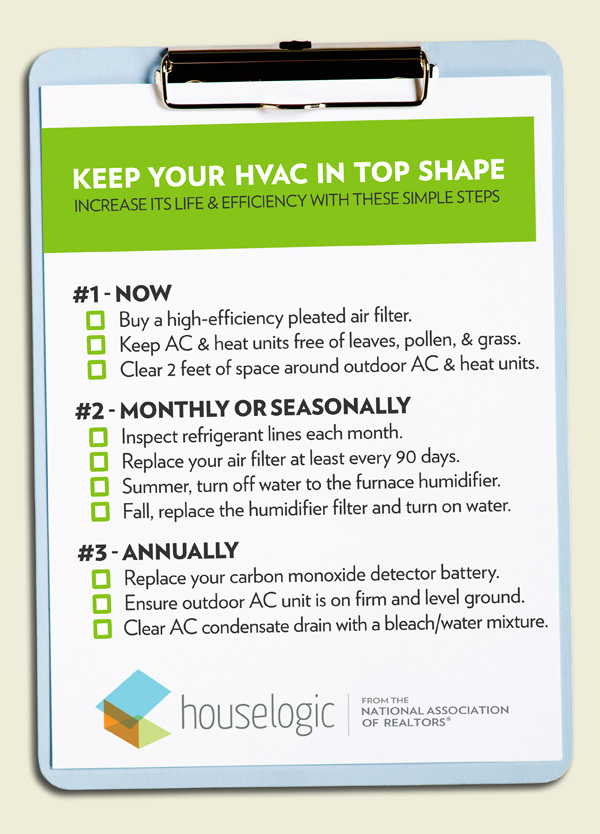
Here’s an easy, doable preventative maintenance checklist to keep your HVAC in top shape.

It’s a good idea to hire a HVAC company to inspect and do maintenance on your system every fall and spring. They’ll do things like inspect and clean the wiring and mechanisms of the unit, which is bit more challenging for the average homeowner.

But you can prolong the life and increase the efficiency of your system if you follow this simple maintenance plan:

HVAC checklist for homeowners

Some things you should do immediately; other tasks only need to be done seasonally or once a year. Here are the steps to a healthy HVAC system:

  • Buy a better filter if you haven’t already. The new high-efficiency pleated filters have an electrostatic charge that works like a magnet to grab the tiniest particles — even those that carry bacteria.
  • Replace the filter at least every 90 days. But check it monthly. If it looks dark and clogged, go ahead and change it. If you have pets, you’ll probably need to change every month.
  • Check to make sure there’s at least two feet of clearance around outdoor air conditioning units and heat pumps.
  • Weekly during spring, summer, and fall remove debris such as leaves, pollen, and twigs from top and sides of outdoor air-conditioning units and heat pumps. Don’t allow the lawn mower to discharge grass clippings onto the unit.
  • Monthly, inspect insulation on refrigerant lines leading into house. Replace if missing or damaged.
  • Annually, ensure that outdoor air-conditioning units and heat pumps are on firm and level ground or pads.
  • Annually, pour a cup of bleach mixed with water down the air-conditioner condensate drain to prevent buildup of mold and algae, which can cause a clog.
  • In summer, shut off the water supply to the furnace humidifier. In fall (or when you anticipate turning on the heat), replace the humidifier wick filter, set the humidistat to between 35% and 40% relative humidity, and turn on the water supply.
  • Never close more than 20% of a home’s registers to avoid placing unnecessary strain on the HVAC system.
  • Annually, replace the battery in your home’s carbon monoxide detector.

Related:

  • How to Inspect Your HVAC
  • How to Use a Programmable Thermostat for Real Savings
  • The 5 Most Effective Ways to Take Back Your Energy Bills


By: Douglas Trattner © Copyright 2015 NATIONAL ASSOCIATION OF REALTORS®


How to Prevent Water Damage

How to Prevent Water Damage

Preventing water damage is a whole lot cheaper than paying for repairs. Here are three easy prevention tips.

Water damage is the No. 1 culprit that weakens your home’s foundation and the very core that holds your house together.

You’ve heard about core strength for your body. Well, water damage hits at the core strength of your house, eventually causing serious structural damage. Damp wood invites termites and carpenter ants; plus, it causes mold and mildew.

Here are three easy things to do to that will give you piece of mind the next time heavy storms hit.

#1. Ensure Good Drainage

Why it matters: Poor drainage weakens your foundation, causing cracks, uneven settling, and pathways for water to enter your home.

How to do it:

  • Clean your gutters routinely. A clogged gutter will send cascades of water down the side of your house, damaging your siding and foundation.
  • Ensure your downspouts direct water 5 to 10 feet away from your house.
  • Make sure your yard is sloped at least 6 inches over a 10-foot span away from your foundation. That slope keeps water from getting down right next to your foundation, where it could cause walls to lean, crack the masonry, and create leaks. (For crawl spaces, keeping water away makes sure excess water doesn’t pool underneath your floor, making for damp conditions that encourage mold, rot, and insects.)
  • But don’t let the soil get too dry, either. Long dry spells let the soil around your house dry out and shrink. A big rain may make the soil expand, putting pressure on your foundation walls. In a drought, run a soaker hose at least 6 inches from the foundation and 3 inches under the soil to keep the soil from contracting and expanding.

Maintenance cost: Very little. Cleaning gutters can be a no-cost DIY job, or you can hire a pro for $50 to $250, depending on the size and height of your home. To get the soil slope you need, you might have to buy some additional topsoil.

Worst case if you put it off: Your foundation could settle, cracking your basement walls. The cost to stabilize, repair, and seal deteriorated foundation walls is a whopping $15,000 to $40,000.

Related:

  • 7 Signs You Have a Foundation Problem
  • How Foundation Repairs Work

#2. Test Your Sump Pump Regularly

Why it matters: Sump pumps come to life during storms. That’s not when you want to realize yours isn’t working properly. You should check it at least once a year, and ideally perform several checks during heavy storm seasons.

How to test your sump pump:

1. Slowly fill the sump pump pit with water. Watch for the “float” (similar to the float in your toilet) to rise, which should turn on the pump. Then watch to make sure the water level falls.

2. Test your backup pump the same way, but unplug the main pump first.

3. If you don’t have a backup pump — or a generator — and are on municipal water, get one that runs on water pressure. If you’re on well water, your only option is the battery kind.

Maintenance cost: Testing is free; a water-powered backup sump pump, including installation, costs $150 to $350; a new battery for a battery-operated sump starts around $200.

Worst case if you put it off: Your basement could flood, ruining everything in it, including drywall and carpeting. (Did you know your regular insurance doesn’t cover flooding?) Plus you run the risk of mold and mildew — which can also be a very expensive problem.

Related: Replacing Your Sump Pump

#3. Check for Water Leaks and Fix Them


Why it matters:
 Persistent leaks lead to mold and mildew, rot, and even termites and carpenter ants (they like chewing soggy wood, since it’s soft). Yet if you fix a leak soon after it starts, there may be no long-term damage at all.

How to check for leaks:

  • Check for dark spots under pipes inside sink cabinets, stains on ceilings, toilets that rock, and of course drips.
  • At least once a year, inspect your roof. Repair missing, loose, and damaged shingles. Repair any cracked caulking and check for leaks around flashing.

Related:

  • How to Inspect Your Roof
  • Tips for Preventing Leaks

Maintenance cost: Negligible for a simple fix, such as a new washer. A visit from a plumber might set you back $250; a roof repair, a few hundred dollars to $1,000.

Worst case if you put it off: Drips ruin the cabinet under the kitchen sink, and run down into the floor sheathing and joists underneath, so you need a structural repair, plus new cabinets and new kitchen flooring. Or the roof rots, so you need a new roof and repairs to rooms directly beneath.

If you do these three things and still have persistent water problems, such as water getting into your basement or an area of your yard keeps washing out, the solution is a bit more complicated in the form of a French drain. Learn about French drains here.


By: Lara Edge © Copyright 2015 NATIONAL ASSOCIATION OF REALTORS®

The owner of this website has made a commitment to accessibility and inclusion, please report any problems that you encounter using the contact form on this website. This site uses the WP ADA Compliance Check plugin to enhance accessibility.